
Tuesday, July 06, 2010
Our Blog has Moved!
We're now hosted on our own domain! Come over to www.beavermtn.com/blog for our brand new blog! And don't worry, we've archived all the great information here and exported it to the new blog, so you won't miss a thing!


Tuesday, June 08, 2010
Did you know?
Did you know that you can put an addition onto a Full Log Home? We recently worked with a couple who live in a 20 year old full log Beaver Mountain home and needed more room. So with a bit of creativity and some unique design work, we helped them add onto their home! It's still a work in progress, but you can see that most of the work is finished now!
Here's what the house looked like before the addition:
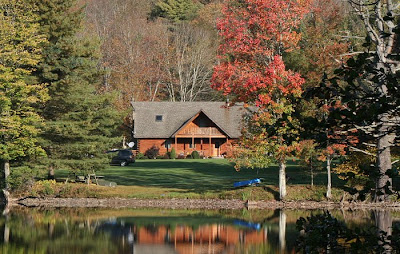
And after (there's still staining to be done on the addition, but the construction part of the project is finished):


The old garage was converted into a bedroom/playroom and then a new garage was added on with a 2nd story. The dormer gave the home an additional 10' of floor space upstairs, which made it possible to split one of the bedrooms into 2. This particular home went from a 2 bedroom to a 4 bedroom with the option of another bedroom over the garage in the future if needed. The rooflines were varied to give it a custom look while still fitting in with the overall design of the original home. The garage and dormers are panelized and sided and the original structure is full log, making this a truly hybrid home.
So whether you're looking to add onto your existing log home or just looking to refresh it with some new design features (maybe a gazebo or a new timber porch), give us a call! 800-233-2770
To follow this addition from the beginning, you can visit their blog at http://lakehouseaddition.blogspot.com/
Here's what the house looked like before the addition:

And after (there's still staining to be done on the addition, but the construction part of the project is finished):


The old garage was converted into a bedroom/playroom and then a new garage was added on with a 2nd story. The dormer gave the home an additional 10' of floor space upstairs, which made it possible to split one of the bedrooms into 2. This particular home went from a 2 bedroom to a 4 bedroom with the option of another bedroom over the garage in the future if needed. The rooflines were varied to give it a custom look while still fitting in with the overall design of the original home. The garage and dormers are panelized and sided and the original structure is full log, making this a truly hybrid home.
So whether you're looking to add onto your existing log home or just looking to refresh it with some new design features (maybe a gazebo or a new timber porch), give us a call! 800-233-2770
To follow this addition from the beginning, you can visit their blog at http://lakehouseaddition.blogspot.com/
Monday, May 03, 2010
Quality Pays !!!

The Maintenance of a Log Home starts when you choose the log home producer!
The amount of maintenance you will have to do to your home, once constructed, is directly affected by the log home package you choose to build. It makes sense that the better built anything is, the less maintenance you will have to perform on it, and the longer the components will last before requiring fixing or replacing.
Yes. Log homes, as does any home, require maintenance. One would expect that. The exterior of a log home is wood that is exposed to the elements. No matter what species of wood, to keep it looking good requires routine applications of a wood preservative and water repellent to keep the wood from absorbing moisture and turning grey and black from oxidation and mildew that builds up in the cells of the wood. This is true for all wood species- either pre-treated or untreated.
Other maintenance however, such as the need for caulking, leveling of the logs and posts, and filling in any gaps that occur over time is directly affected by the quality of materials used and the preparation of the logs. These things can be minimized with a little TLC (a.k.a. Total Log Care here at Beaver Mountain) before the house is constructed.
The amount of maintenance you will have to do to your home, once constructed, is directly affected by the log home package you choose to build. It makes sense that the better built anything is, the less maintenance you will have to perform on it, and the longer the components will last before requiring fixing or replacing.
Yes. Log homes, as does any home, require maintenance. One would expect that. The exterior of a log home is wood that is exposed to the elements. No matter what species of wood, to keep it looking good requires routine applications of a wood preservative and water repellent to keep the wood from absorbing moisture and turning grey and black from oxidation and mildew that builds up in the cells of the wood. This is true for all wood species- either pre-treated or untreated.
Other maintenance however, such as the need for caulking, leveling of the logs and posts, and filling in any gaps that occur over time is directly affected by the quality of materials used and the preparation of the logs. These things can be minimized with a little TLC (a.k.a. Total Log Care here at Beaver Mountain) before the house is constructed.
A) Proper drying of the logs will stabilize them and minimize shrinking and twisting.
B) The grade of the logs will reflect the amount of checking, the slope of the grain and the size of the knots allowed in the logs and timbers as well as the structural integrity. The better the grade, the less chance of large checks occurring, knot fallout, and bowing and splitting of the logs.
C) Shaping the logs after the drying process will mill out many of the checks that occurred during the drying process.
D) The use of specialty tools to cut and cope the logs, and air tight joinery between the logs and at all joints is essential to minimize the maintenance on the home. Cuts done in the factory by specialized equipment and stationary saws are sure to be more accurate and air tight than those done by hand held saws or chainsaws in the field. Drilling lag bolt holes and making the log butt joint spline grooves in the factory will be more accurate than drilling dowel holes between the logs in the field.
All of these things directly affect the performance of you new home, the energy efficiency, and protect the value of your investment over time.
So ask questions, look closely at the details of construction, find out how the cuts are done, and become an informed shopper. Your home is a large investment. You want to enjoy it, not be a slave to it! Quality may cost more up front, but it helps protect your investment and will save you time and money in the future. - Joan Decker
All of these things directly affect the performance of you new home, the energy efficiency, and protect the value of your investment over time.
So ask questions, look closely at the details of construction, find out how the cuts are done, and become an informed shopper. Your home is a large investment. You want to enjoy it, not be a slave to it! Quality may cost more up front, but it helps protect your investment and will save you time and money in the future. - Joan Decker
Give us a call and schedule a Consultation Today! 1-800-233-2770
Friday, April 23, 2010
The Big Day...
 Anyone who dreams of buildng a log home anxiously awaits the day the first truck comes rolling in with their log materials in tow. All the time, preparation and hard work is finally paying off. The Construction phase is about to begin!
But wait not so fast...
For those who build a Beaver Mountain Log Home there is another day that rivals delivery day- IT IS YOUR DRY-STACK!
Become a FAN of Beaver Mountain Log & Cedar Homes on Facebook to watch the progress!
Call 1 800-233-2770 for your consultation!
Saturday, April 17, 2010
Another Happy Homeowner...

As the spring building season begins to ramp up it is always nice to receive feedback from our extended beaver mountain family and friends. This letter came just the other day and it speaks directly to what makes the Beaver Mountain home building experience truly special.
Hi Chris,
... We built the Grand View model home two years ago and enjoy it so much. We loved working with all of you at Beaver Mountain. The quality of the logs and other materials are just first class as is your follow up service whenever we needed advice and support. Rick Denman and his brothers are amazing quality builders and the craftsmen they employ and recommend are also first rate. We couldn't be happier and highly recommend the Grand View and Rick Denman to all who are fortunate to be interested in working with your company and product.
Everyone who enters our home always comments on the beautiful design of the home. It is so unique in log homes because it is a blend of rustic charm with high end sophistication. I humbly take credit but secretly know it was your company's designers who gave us a great product and glorious floor plan to work with... - Kathy H, 2008 BM Homeowner
If you are ready to begin planning your dream home we would love to help. Please give us a call and schedule a consultation today! 1-800-233-2770
Monday, March 22, 2010
Renewable Energy Seminar Series: ETM SOLAR WORKS

Beaver Mountains Renewable Energy Seminar Series continues ...
Solar Energy: What you need to know!
Saturday April 10th @ 1:30 pm
Presented by Wendy Barnum
Wendy Barnum of ETM Solar Works (http://www.etmsolar.com/) will be our guest speaker as she presents an introductory seminar on solar energy. With nearly 22 years of experience, ETM Solar Works is the oldest installer of solar energy systems in New York State. This 30 minute presentation will provide information on:
- Debunking the myth that New York is not a viable solar state
- Types of Solar Energy Systems
- Available government incentives to offset initial cost
- Net metering and much, much more...
Call Today to register as seating is limited!
1 (800) 233-2770
Sunday, March 14, 2010
Your first visit...What should you expect?

The most exciting part of planning your new home is thinking ahead to living in it! The floor plan, the kitchen design, the great room fireplace, the master bath oasis, and the foyer entryway are all important to you. If driving up your driveway to your log home with an inviting front porch is your ultimate goal then proper planning is essential.
During your initial meeting, several items will need to be discussed, and decisions will need to be made before you can even think about designing your kitchen or bath. It is during this time that your consultant can begin to guide you through your project and smooth out some of those inevitable road bumps that may pop up along the way.
Your consultation should consist of the following:
A list of your questions at the ready.
Any question you may have should be asked. Nothing is “a silly question” If you don’t know, ask. We are here to help!
During your initial meeting, several items will need to be discussed, and decisions will need to be made before you can even think about designing your kitchen or bath. It is during this time that your consultant can begin to guide you through your project and smooth out some of those inevitable road bumps that may pop up along the way.
Your consultation should consist of the following:
A list of your questions at the ready.
Any question you may have should be asked. Nothing is “a silly question” If you don’t know, ask. We are here to help!
Your consultant will have questions as well.
Expect a discussion of your lot, your lifestyle (present and future), your timeframe for building, the size and style home you want to build, and your budget.
A demonstration and explanation of the details of construction.
Though this may not be of real interest to you, frankly, it should be. This home you are planning is likely a home you have envisioned for a long time. You want to enjoy it for years, decades. The construction, and materials used will affect not only the quality of the home, but it’s efficiency, longevity, and the maintenance you will need to perform in the future. Details are important. Look at them closely.
A demonstration and tour of our (3) model homes
If possible, if the opportunity arises, you should also tour the manufacturing facility of the manufacturer. Whether during the appointment or at a later date, This will allow you to see firsthand the care taken in preparation of the materials for your home.
Your home is likely one of the largest investment you will make in your lifetime.
It should be as important to the consultant as it is to you that sufficient time is taken to be sure you are educated to enable you to make a sound decision on the product, manufacturer, and house plan so that you ultimate goal is met … A beautiful, well constructed home that will be enjoyed by you and your family for decades.
Give us a call and let's get started!
1-800-233-2770
Thursday, March 11, 2010
Sat 3/13 @1:30 pm...Unveiling the Secrets about Renewable Energy
NEW SEMINAR SERIES!!!
"Unveiling the Secrets About Renewable Energy"
Total Green and Beaver Mountain Log & Cedar Homes are sponsoring a special seminar to teach you what you need to know about Renewable Energy. Discover How You Can Heat, Cool and Enjoy Hot Water Without Burning Any Fossil Fuel and Never Purchase Oil, Gas or Propane Again.
Presented by Paul Auerbach, a Leading Expert in Geothermal Technology and Energy-Centric Construction - Accredited by AIA, The National Society of Professional Engineers & Central Hudson Utilities. Learn:
-The Pros and Cons of Solar, Wind & Geothermal
-Real Benefits & Payback
-Energy Efficiency Strategies
-The Environmental Impact
-30% Renewable Energy Tax Credits
Saturday March 13, 2009 @ 1:30pm
Register Today- 1-800-233-2770
Seminar will be held at the Beaver Mountain Design Center on Route 17/I-86 near Hancock, NY following the Beaver Mountain Mill Tour & Log Building Workshop*www.totalgreenus.com
*Limited space available - by reservation only. Mill Tour & Log Building Workshop begins at 10am. Renewable Energy Seminar begins at 2pm. You must register for each event separately.
"Unveiling the Secrets About Renewable Energy"
Total Green and Beaver Mountain Log & Cedar Homes are sponsoring a special seminar to teach you what you need to know about Renewable Energy. Discover How You Can Heat, Cool and Enjoy Hot Water Without Burning Any Fossil Fuel and Never Purchase Oil, Gas or Propane Again.
Presented by Paul Auerbach, a Leading Expert in Geothermal Technology and Energy-Centric Construction - Accredited by AIA, The National Society of Professional Engineers & Central Hudson Utilities. Learn:
-The Pros and Cons of Solar, Wind & Geothermal
-Real Benefits & Payback
-Energy Efficiency Strategies
-The Environmental Impact
-30% Renewable Energy Tax Credits
Saturday March 13, 2009 @ 1:30pm
Register Today- 1-800-233-2770
Seminar will be held at the Beaver Mountain Design Center on Route 17/I-86 near Hancock, NY following the Beaver Mountain Mill Tour & Log Building Workshop*www.totalgreenus.com
*Limited space available - by reservation only. Mill Tour & Log Building Workshop begins at 10am. Renewable Energy Seminar begins at 2pm. You must register for each event separately.
Tuesday, March 02, 2010
Mill Tour & Log Building Workshop: Sat. March 13th
Mill Tour & Log Building Workshop
Saturday March 13th @ 9 30 am
Are you looking for an investment that will bring great returns?
If so, we would like to invite you to invest a few hours of time and take that first step in planning your dream home!
Beaver Mountain has scheduled its 2nd Mill Tour and Log Building Workshop of 2010 on Saturday March 13th at 9:30am. Learn first hand what sets a Beaver Mountain home apart.
· Tour our (3) Model Homes, Showroom and Design Center.
· See first hand how our custom homes are manufactured and produced.
· Walk through a dry-stacked/ pre-assembled log home
· Meet with members of our sales and technical team and have all of YOUR questions answered.
CALL TODAY TO REGISTER AS SPACE IS LIMITED!
1-800-233-2770
“We just had to let you know how much we enjoyed our day at Beaver Mountain. The Mill Tour was extremely informative and helpful. The laid back and pressure free atmosphere was especially appreciated.”- Ned & Sandy 11/8/02
Saturday March 13th @ 9 30 am
Are you looking for an investment that will bring great returns?
If so, we would like to invite you to invest a few hours of time and take that first step in planning your dream home!
Beaver Mountain has scheduled its 2nd Mill Tour and Log Building Workshop of 2010 on Saturday March 13th at 9:30am. Learn first hand what sets a Beaver Mountain home apart.
· Tour our (3) Model Homes, Showroom and Design Center.
· See first hand how our custom homes are manufactured and produced.
· Walk through a dry-stacked/ pre-assembled log home
· Meet with members of our sales and technical team and have all of YOUR questions answered.
CALL TODAY TO REGISTER AS SPACE IS LIMITED!
1-800-233-2770
“We just had to let you know how much we enjoyed our day at Beaver Mountain. The Mill Tour was extremely informative and helpful. The laid back and pressure free atmosphere was especially appreciated.”- Ned & Sandy 11/8/02
Monday, February 22, 2010
What is a "True" Log Home?

Log homes are a method of construction and like all types of construction; they have their own unique character as well as their specific strengths and limitations. This means that there are applications where logs will exceed or out perform conventional framed construction methods (this is particularly true in the first floor walls), while in other areas conventional framing may be the better choice!
As I noted, log homes are a type of construction. Most of us think of log homes differently from a conventional home. We tend envision a rustic look with large timbers often hand hewn coupled with stone fireplaces and large decks porches, etc. Often the western or Adirondack style lodges come to mind. This also leads to question of authenticity or the question “is that really a log home?” When I point out to people that many of the great lodges used a lot of steel in their construction they are surprised and comment, “Gee it never occurred to me.” Let’s face it, today’s log homes look nothing like they did a hundred years ago to say nothing of just the last ten years – think about it, ten years ago you would not have heard much about spray foam insulation and geothermal HVAC systems! It’s also worth noting that log homes just within North America have a great deal of regional variations and those variations become even greater as we look to the rest of the world.
So, next time someone asks you what a "True" log home is, tell them it's whatever you want it to be!
Interested in learning more about how Beaver Mountain Log & Cedar Homes can help you with your dream home? Give us us a call @ 1-800-233-2770 and schedule a personal consultation today.
Tuesday, February 16, 2010
Spring is just around the corner!

Furious February Snows!
Don't let them fool you,
Spring IS just around the corner!!
I think the reason the season is called "Spring" is that it "springs" up on us. It seems that overnight the white frozen landscape is gone and suddenly we are looking at green grass, budding trees, and crocus blossoms pushing up through the warming earth.
I am still talking to people who 'plan to build in the spring', yet they have made no decisions on a house plan, a builder or begun any of the myriad of tasks that need to be done before the ground can be excavated and the house construction can begin!
SPRING WILL BE HERE BEFORE YOU KNOW IT. Daylight savings time begins in just 3 weeks!
Let's get started!
Call 1-800 233-2770 for a personal consultation today!
Thursday, February 11, 2010
We are having some technical problems with our website.
Please note that if you have requested for an 11x17 drawing that we may not have received your request. We are addressing the issue and it will be fixed shortly. If you have requested a drawing please call us at 1-800-233-2770 so we can get that out to you as quickly as possible. Thank you
Thursday, February 04, 2010
Mill Tour...Workshop... Sat. Feb. 13th
YOU'RE INVITED to take that first step in planning your dream home!
Beaver Mountain has scheduled its first Mill Tour and Log Building Workshop of 2010 on Saturday Feb. 13th 9 30am.
Beaver Mountain has scheduled its first Mill Tour and Log Building Workshop of 2010 on Saturday Feb. 13th 9 30am.
Learn first hand what sets a Beaver Mountain home apart.
· Tour our(3) Model Homes, Showroom and Design Center.
· See first hand how our custom homes are manufactured and produced.
· Walk through a dry-stacked/ pre-assembled log home
· Meet with members of our sales and technical team and have all of YOUR questions answered.
CALL TODAY TO REGISTER AS SPACE IS LIMITED!
1-800-233-2770
“We just had to let you know how much we enjoyed our day at Beaver Mountain. The Mill Tour was extremely informative and helpful. The laid back and pressure free atmosphere was especially appreciated.”
· Tour our(3) Model Homes, Showroom and Design Center.
· See first hand how our custom homes are manufactured and produced.
· Walk through a dry-stacked/ pre-assembled log home
· Meet with members of our sales and technical team and have all of YOUR questions answered.
CALL TODAY TO REGISTER AS SPACE IS LIMITED!
1-800-233-2770
“We just had to let you know how much we enjoyed our day at Beaver Mountain. The Mill Tour was extremely informative and helpful. The laid back and pressure free atmosphere was especially appreciated.”
- Ned & Sandy 11/8/08
Monday, January 25, 2010
NEW Webinar- Jan. 27th: 10 Construction Details...

Wednesday January 27th @ 7pm
Shhh… We have a secret!
10 construction details that should matter when bidding and building a Beaver Mountain Log Home.
How important is energy efficiency in your new log home?
Shhh… We have a secret!
10 construction details that should matter when bidding and building a Beaver Mountain Log Home.
How important is energy efficiency in your new log home?
Would you prefer to keep exterior maintenance to a minimum?
Do you believe all ‘pre-cut’ packages are the same?
Building Consultant Frank Myka and the Beaver Mountain family invite you to attend a web based seminar from the convenience of your own home! This 30 minute seminar will introduce you to the technical aspects of Beaver Mountain’s Builder Friendly ‘pre-cut’ home building system.
Register today and learn why all log homes are not created equal!https://www1.gotomeeting.com/register/897452224
Register prior to 4:00 Pm and log onto the seminar by 6:45PM January 27.
For More Information Call 800-233-2770
Register today and learn why all log homes are not created equal!https://www1.gotomeeting.com/register/897452224
Register prior to 4:00 Pm and log onto the seminar by 6:45PM January 27.
For More Information Call 800-233-2770
Wednesday, January 13, 2010
Web Based Seminar...You're Invited!!

Wednesday January 27th @ 7pm
Shhh… We have a secret!
10 construction details that should matter in your log home!
How important is energy efficiency in your new log home?
Would you prefer to keep exterior maintenance to a minimum?
Do you believe all ‘pre-cut’ packages are the same?
Building Consultant Frank Myka and the Beaver Mountain family invite you to attend a web based seminar from the convenience of your own home! This 30 minute seminar will introduce you to the technical aspects of Beaver Mountain’s Builder Friendly ‘pre-cut’ home building system.
Would you prefer to keep exterior maintenance to a minimum?
Do you believe all ‘pre-cut’ packages are the same?
Building Consultant Frank Myka and the Beaver Mountain family invite you to attend a web based seminar from the convenience of your own home! This 30 minute seminar will introduce you to the technical aspects of Beaver Mountain’s Builder Friendly ‘pre-cut’ home building system.
Register today and learn why all log homes are not created equal!
https://www1.gotomeeting.com/register/897452224
https://www1.gotomeeting.com/register/897452224
For More Information Call 800-233-2770
Monday, December 28, 2009
Forgotten Flare
 When planning your dream home, it may seem that the list of design decisions is endless. The process tends to begin with bigger concepts, like cape versus chalet, and funnels down to the finer details, such as faucet style and finish. In between, decisions have been made on timber joist style, shingle color and lighting placement. What do all of these decisions have in common? They are all about integral parts of a home. The project can not proceed without someone asking these questions. When planning your home, don't forget the design decisions which are not required parts of the structure.
 Gables trusses, window trim, stepped overhangs, timber purlins and over-sized fascia are just a few examples of the details which will give your home architectural flare. Talk with your sales consultant about including design elements which will set your dream home apart.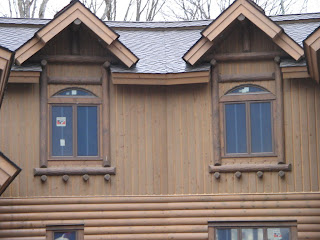
Wednesday, December 23, 2009
"Perfectly Planned"

Visualization... Collaboration... Realization!
Close your eyes and imagine your dream home? What does the great room look like? How about the property... Are you on an open hillside or overlooking a lake or stream? Are you nestled in the woods? Is there a piano, a library filled with cherished books, or a room for trophies you have collected over a lifetime.
These are the ideas you need to bring to the design table. A home rich with the things you love will bring contentment far into the future. The design team here at Beaver Mountain takes your dreams, wants and needs and creates that perfect home.
Your design ideas may change slightly throughout the process but with the depth of experience at Beaver Mountain, everything will ultimately fall into place. The Beaver Mountain Design Team is here to guide and advise you. If you’re thinking about breaking ground within the next 12 months, now is the time to take the first step and book your consultation.
Call 800-233-2770 today!
Thursday, December 10, 2009
DeckWood Facts & Care
Outdoor living areas have increasingly become popular for barbecuing, entertaining or simply for relaxing and enjoying nature. Because of the amount of time spent on decks and porches, consumers are demanding higher quality building products for these areas. Beaver Mountain has a reputation for supplying high quality materials, and our exterior decking is no exception.
DeckWood is a hand-selected clear grade of southern yellow pine without knots or wane. The top edges of the 2x6 lumber is rounded for a distinctive look and the underside is milled with double grooves to reduce the tendency of decking to cup. DeckWood is pressure-treated with Wolman preservative and is therefore backed by both the Wolmanized wood lifetime limited warranty against termites and fungal decay and also by the Good Housekeeping Seal.
Beaver Mountain provides screws for DeckWood installation which must be predrilled for the best result. According to Arch Treatment Technologies, manufacturer of Wolman preservative, an effective brand of water repellent should be applied to the decking as soon as the project is finished or, for large projects, as sections are completed. Water repellent should be re-applied every year or two and deck brightener can be used to clean wood which has a dingy appearance caused by dirt, mildew and mold.
For further information, please visit http://www.wolmanizedwood.com/
DeckWood is a hand-selected clear grade of southern yellow pine without knots or wane. The top edges of the 2x6 lumber is rounded for a distinctive look and the underside is milled with double grooves to reduce the tendency of decking to cup. DeckWood is pressure-treated with Wolman preservative and is therefore backed by both the Wolmanized wood lifetime limited warranty against termites and fungal decay and also by the Good Housekeeping Seal.
Beaver Mountain provides screws for DeckWood installation which must be predrilled for the best result. According to Arch Treatment Technologies, manufacturer of Wolman preservative, an effective brand of water repellent should be applied to the decking as soon as the project is finished or, for large projects, as sections are completed. Water repellent should be re-applied every year or two and deck brightener can be used to clean wood which has a dingy appearance caused by dirt, mildew and mold.
For further information, please visit http://www.wolmanizedwood.com/
Tuesday, December 01, 2009
WOODguard Preservative
One of the products available from Beaver Mountain for staining your log home is the oil based preservative WOODguard.
Available in a number of colors, WOODguard is a highly durable, transparent stain designed for log homes and siding. Several ultra violet blocking pigments work to protect the finish from damaging UV rays. The oil based formula provides long-term protection and water repellency by penetrating deeply into the wood. WOODguard utilizes an active ingredient known as Copper 8-Quinolinolate which acts to control mold, decay, termites and anobiid powderpost beetles.
Application should take place only if overnight low temperatures are above 50 degrees F and daytime high temperatures do not exceed 95 degrees F. WOODguard is easily applied by sprayer, brush or roller. See manufacturer's instructions for specific preparation and application directions.
Contact Mike in Customer Service for more information on WOODguard and all other products available from Beaver Mountain.
Available in a number of colors, WOODguard is a highly durable, transparent stain designed for log homes and siding. Several ultra violet blocking pigments work to protect the finish from damaging UV rays. The oil based formula provides long-term protection and water repellency by penetrating deeply into the wood. WOODguard utilizes an active ingredient known as Copper 8-Quinolinolate which acts to control mold, decay, termites and anobiid powderpost beetles.
Application should take place only if overnight low temperatures are above 50 degrees F and daytime high temperatures do not exceed 95 degrees F. WOODguard is easily applied by sprayer, brush or roller. See manufacturer's instructions for specific preparation and application directions.
Contact Mike in Customer Service for more information on WOODguard and all other products available from Beaver Mountain.
Monday, November 16, 2009
Class is in Session!!!

WEBINAR WAS A SUCCESS !
We want to thank everyone who tuned in to the first Beaver Mountain Webinar broadcast.
We hosted ourfirst Webinar on November 11th and the feedback was very
positive. Titled “Home Planning Seminar”; we touched on site selection and preparation,
financing, design, the ordering process and log construction.
Beaver Mountain plans to offer this webinar as well as others in the future.
We want to thank everyone who tuned in to the first Beaver Mountain Webinar broadcast.
We hosted ourfirst Webinar on November 11th and the feedback was very
positive. Titled “Home Planning Seminar”; we touched on site selection and preparation,
financing, design, the ordering process and log construction.
Beaver Mountain plans to offer this webinar as well as others in the future.
We’ll be sure to post information on the next one, here, on our blog
or call us at 1-800-233-2770!
Subscribe to:
Posts (Atom)

 Posts
Posts


